
Let’s Reset the System: Make Weddings Meaningful

Mind Over Matter: How Gurindervir overcame a Confidence Dip to Make Himself the Fastest Indian
May 25, 2026
Mother Dairy’s Tribute to Mother Nature: Brands Need to Rethink Packaging
June 5, 2026
Twisha or Deepika were not close relatives or friends of anyone of us yet their going away in the most brutal manner has shaken many. There is palpable anger and unmatched media frenzy around the dowry deaths of young promising, beautiful girls in their 20s or early 30s who succumbed to dowry or demands of boy’s families from the day the wedding was fixed. When the escalating demand was not fulfilled by the girl’s family, these girls of 21st century were met with atrocities by husbands and in-laws. Those who were meant to be the protectors turned out to be the perpetrators.
2026 and we are still talking dowry!
Being a Miss Pune implies that Twisha had been a confident young woman with a dynamic personality. Just like any other girl, she also followed the trajectory of following a career path and then a marriage after dating a man, whom she found through a dating app. However, Twisha Sharma met with the most unfortunate fate just five months into the marriage. The case has been hitting headlines with ample media glare.
The case drew attention initially as a dowry death case and atrocities by the now infamous mother-in-law and husband, now facing legal proceedings. Simultaneously, another case of dowry death emerged from Greater Noida where a beautiful 24-year-old girl Deepika Narang was found dead 1.5 years post wedding. Her family says that they gave a Scorpio, Rs 11 lacs in cash whereas the new bride was soon harassed due to further dowry demands.
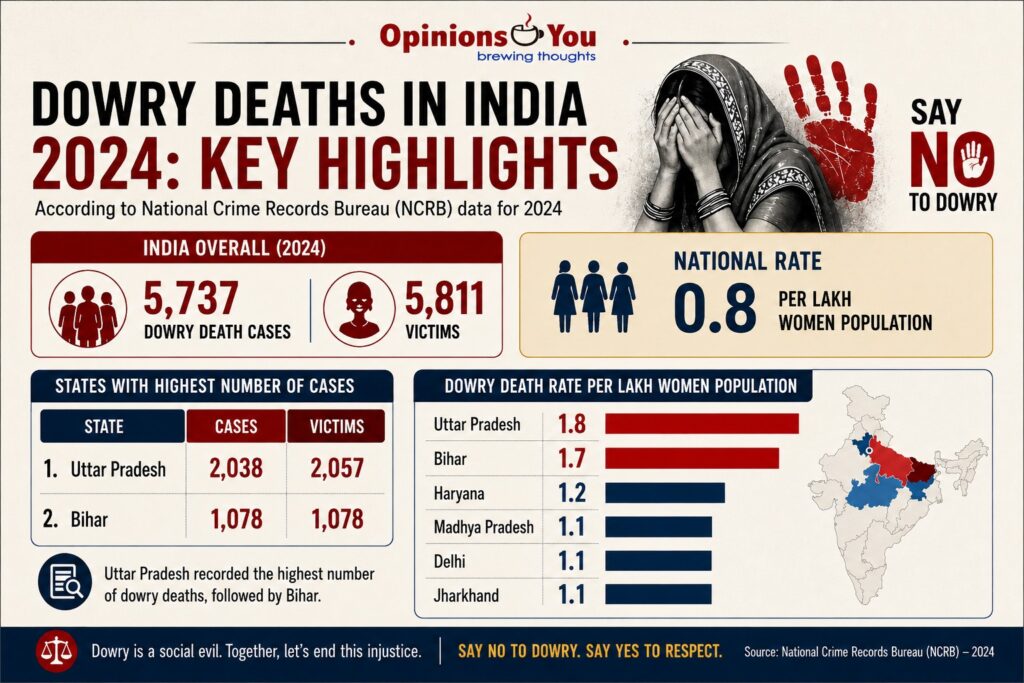
There is immense media frenzy around Twisha’s case as many other dowry deaths were reported around the same time. As per National Crime Records Bureau (NCRB), India recorded 5,737 dowry deaths in 2024. Giving and receiving dowry was made illegal in India, but it is still widely practised.
The Dowry Prohibion Act, 1961 (Act No: 28 of 1961) prohibits the evil practice of giving and taking of dowry. The Act defines dowry as any property or valuable security given directly or indirectly in connection with marriage.
Key Provisions of the Act
- Giving, taking or abetting dowry is punishable with imprisonment of at least five years and a fine.
- Demanding dowry directly or indirectly is also a punishable offence.
- Any agreement involving dowry is considered void under the law.
- Dowry received must legally belong to the wife or her heirs.
- Offences under the Act are non-bailable and non-compoundable.
Additional Legal Protections
The Act works alongside provisions of the Indian Penal Code:
- Section 304-B addresses dowry death, with punishment ranging from seven years to life imprisonment.
- Section 498-A deals with cruelty by husband or relatives connected to dowry harassment.
Purpose of the Act
The law was introduced to eliminate the social evil of dowry and protect women from harassment, violence and exploitation linked to marriage-related demands.
This was the time when large number of dowry deaths were reported and married women were burnt alive. However, it would be a mistake to think that burning of brides has stopped. In 2025, Nikki Bhati, who was 28-years-old, died of severe burn injuries after being allegedly set on fire at her marital home near Greater Noida. She was brutally beaten and then set on fire in front of her children. This gory incident happened just around the national capital.
Why are we still paying dowry?
Rather than asking why dowry is being demanded, more important question here is why dowry is still being paid. Why the girl’s families are still kneeling down and making every effort beyond their means to fulfil the demands from boy’s families? While the girls are financially independent now yet the marriage mindsets remain traditional. Even when the boy and the girl decide to spend the rest of their lives together and once the marriage mode is on, all conventions start appearing in the form of an extravagant wedding which is mostly organized by girl’s family. There are expensive gifts and cash given to boy and his family, which sets the tone for escalated expectations
Isn’t it time that we actually soleminize weddings for what they are meant to be: More meaningful, more close knit and full of warmth, love and laughter. If religious rituals are followed, there is all the more reason to keep the wedding simple focusing on understanding the significance of traditions rather than exorbitant spending on a lavish wedding which could be a debt trap.

Why have weddings become extravagant displays of wealth, often creating space for expectations and demands that have little to do with the true purpose of the occasion?
The real focus should be on the marriage itself—a lifelong partnership where two individuals come together to build a relationship founded on trust, respect, companionship, and mutual support.
When celebrations become more important than the commitment they are meant to honour, we risk losing sight of what truly matters. Grand venues, lavish decorations, and excessive spending may create a spectacle for a day, but it is the strength of the relationship that determines a lifetime of happiness.
It’s time to simplify weddings and restore meaning to marriage. Let us celebrate love, commitment, and shared values rather than social status and financial display. A simpler wedding can be just as beautiful—while allowing couples and families to begin this new chapter free from unnecessary financial and social pressures.
Let’s make marriages stronger by making weddings simpler.