India Scales Up AI Ambitions with 20,000 More GPUs at India AI Impact Summit 2026

From Odisha’s Villages to Global Capital Markets: The Rise of Annapurna Finance
February 18, 2026
The Leading Lady of Sports – Smriti Mandhana
February 20, 2026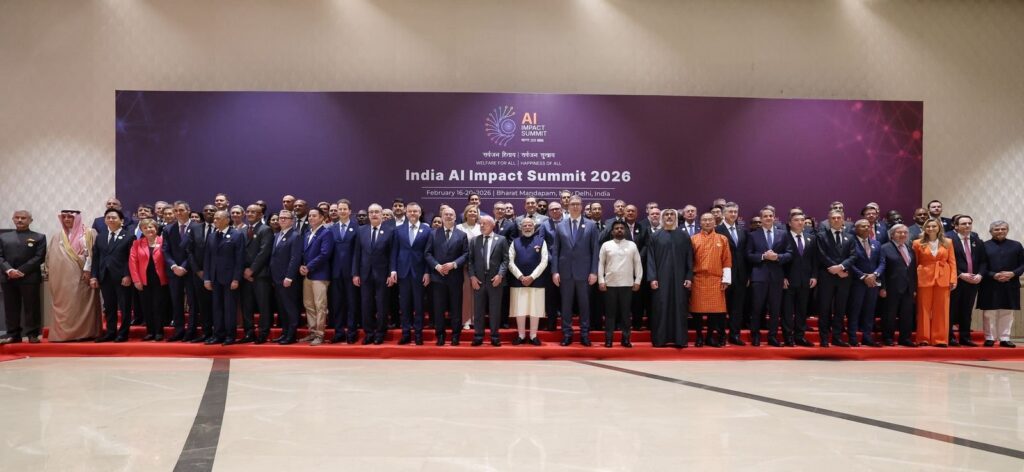
India has signaled a major acceleration in its artificial intelligence ambitions, announcing a substantial expansion of its national compute capacity at the India AI Impact Summit 2026.
Union Minister for Electronics and Information Technology Ashwini Vaishnaw revealed that the country will add 20,000 Graphics Processing Units (GPUs) to its existing base of 38,000 GPUs in the coming weeks. The move will take India’s total AI compute capacity beyond 58,000 GPUs — a scale that places it among the world’s most heavily invested AI ecosystems.
The announcement was made during the second day of the Summit at Bharat Mandapam, where policymakers, technologists and global leaders have gathered for what organisers describe as the largest AI-focused event in the world.
“This is the next phase of India’s AI strategy,” the Minister said, underscoring that the expansion is not merely about hardware but about widening access and strengthening responsible deployment.
A Strategic, Not Symbolic, Expansion
The Summit, themed Sarvajan Hitaya, Sarvajan Sukhaya — Welfare for All, Happiness of All — has positioned AI not just as a technological pursuit but as a development imperative. The GPU expansion reflects a broader effort under the ₹10,300+ crore IndiaAI Mission to democratise access to high-end computing infrastructure.
Currently, startups, researchers, students and public institutions can access GPUs under the Mission at ₹65 per hour — a pricing model aimed at lowering entry barriers in a field typically dominated by large corporations.
In many parts of the world, advanced AI infrastructure remains concentrated in the hands of a few private entities. India’s approach seeks to create a more distributed innovation ecosystem, where compute power, datasets and models are available to a wider community.

Leadership from the Global South
The Summit opened on February 16 with Prime Minister Narendra Modi inaugurating the India AI Impact Expo at Bharat Mandapam. The symbolism was hard to miss: a defining global AI conversation unfolding in the Global South, led by India.
Over 20 Heads of State, 60 Ministers and more than 500 global AI leaders are participating in the five-day event. Policymakers are engaging directly with researchers and industry executives, while startups and academic institutions are forging partnerships.
The government estimates that more than USD 200 billion in investments could flow into India’s AI ecosystem over the next two years, reflecting growing international confidence in the country’s AI roadmap.

From Compute to Capability
Beyond infrastructure, the Summit has showcased India’s progress in sovereign AI model development. Several Indian models launched at the event were benchmarked against leading international systems, with organisers claiming competitive or superior performance across multiple parameters.
Global recognition has also bolstered India’s standing. Stanford University has recently ranked India among the top three AI nations globally — a milestone that aligns with the country’s growing talent pool and expanding infrastructure.
The government has also unveiled six sectoral AI Impact Casebooks featuring over 170 deployed and scalable AI solutions across health, agriculture, education, energy, accessibility and gender empowerment. Officials emphasised that these are not experimental pilots but operational systems delivering measurable outcomes.
Governance, Inclusion and Sustainability
The Summit’s discussions have been structured around three guiding principles — People, Planet and Progress — and operationalised through seven thematic “Chakras,” covering areas such as human capital, safe and trusted AI, sustainability, scientific advancement and economic growth.
Sessions have focused on AI in governance, public health, workforce transformation and scalable applications. RailTel Corporation of India Ltd curated discussions on AI-powered public health systems, exploring collaborative models for inclusive healthcare delivery.
A session titled AI in Governance: Revolutionising Government Efficiency examined how artificial intelligence can move beyond pilot projects to system-level deployment across public services.
Meanwhile, more than 2.5 lakh students across India took a pledge on the first day of the Summit to use AI responsibly — an initiative submitted to Guinness World Records for recognition.
Infrastructure as a Signal
Experts note that large-scale AI capability depends fundamentally on compute power. The addition of 20,000 GPUs is therefore more than a numerical upgrade; it is an infrastructure signal.
With the expansion from 38,000 to over 58,000 GPUs, India is demonstrating that its AI ambitions are backed by tangible capacity. As the Summit progresses, the message emerging from New Delhi is clear: India is not content to be a consumer in the AI revolution. It intends to be a builder, a regulator and a global contributor — shaping a model of AI development that combines scale with inclusivity and innovation with responsibility.