
From Odisha’s Villages to Global Capital Markets: The Rise of Annapurna Finance

EU Rallies for Payment Over Copyrighted Usage by AI
January 29, 2026
India Scales Up AI Ambitions with 20,000 More GPUs at India AI Impact Summit 2026
February 19, 2026
In 2005, long before global lenders took notice, a small team under Mission Annapurna was walking door-to-door in the interior villages of Odisha, speaking to women who had never stepped inside a bank.
Those early efforts, launched under the non-profit People’s Forum, were simple yet transformative — providing small loans to economically vulnerable women and bringing financial services to communities considered too remote or unprofitable by formal institutions.
Two decades later, that grassroots initiative has evolved into Annapurna Finance Private Limited (AFPL), now ranked among India’s top non-banking financial companies in the microfinance space.
A Mission Rooted in Inclusion
Established in 2009 as Annapurna Microfinance Pvt. Ltd., the organisation’s transitioned from an NGO to a more structured entity scaled its impact. In 2013, it registered with the Reserve Bank of India as an NBFC–MFI, formalising its role within India’s regulated financial ecosystem.
Its mandate remained unchanged: serve economically backward clients — particularly women — and reach areas where mainstream banks find it commercially unviable to operate.
Over the years, Annapurna Finance expanded beyond basic microcredit. It began offering diversified, need-based financial products designed to support customers throughout different stages of their economic lives. Alongside credit, the institution introduced technical and entrepreneurial support, helping clients strengthen their businesses and household resilience.
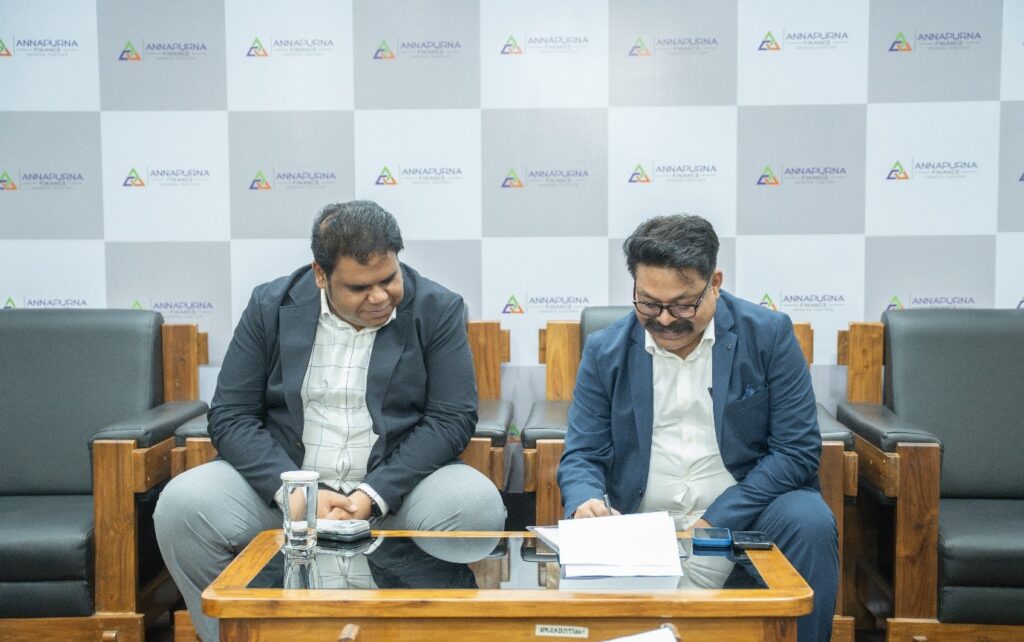
A Milestone Transaction
The organisation recently marked a significant financial milestone by securing a USD 100 million syndicated multi-currency term loan facility, along with a USD 50 million greenshoe option. The facility, denominated in USD and JPY, is structured as a social loan — reinforcing its focus on inclusive and responsible finance.
The transaction was led by Standard Chartered Bank, which acted as Sole Mandated Lead Arranger, Underwriter, and Bookrunner.
For Annapurna Finance, the deal signals more than access to capital. It represents growing international confidence in India’s microfinance sector and in the institution’s governance standards and operating model.
“This transaction is more than fundraising — it’s a defining milestone for our institution,” said Dibyajyoti Pattanaik, Director, Annapurna Finance Private Limited. “In a challenging global liquidity environment, its size and timing reflect strong confidence in Annapurna’s model and governance. Diversified, long-term global capital strengthens our balance sheet and reinforces our commitment to sustainable financial inclusion, women empowerment, and climate resilience in India.”
The latest facility builds on a USD 109.5 million syndicated loan concluded last year, also led by Standard Chartered Bank, further underlining sustained market trust.
Bridging the Financial Divide
Today, Annapurna Finance ranks as the fourth-largest NBFC–MFI in India. It combines an extensive on-ground distribution network with technology-enabled systems to improve operational efficiency and transparency. Yet, at its core, the institution continues to rely on the same principle that defined its early days — doorstep engagement.
By expanding formal credit access and strengthening micro-entrepreneurship, the company seeks to deepen financial inclusion across its operational footprint.
From modest beginnings in Odisha’s villages to raising multi-currency capital from global lenders, Annapurna Finance’s journey reflects the broader evolution of India’s microfinance landscape — where social mission and structured finance increasingly intersect.